You’ve seen the phrase before. Handcrafted. Made with love. Woven with care.
In fashion, these words have been used so often, on so many labels, by so many brands, that they’ve almost lost their meaning. They’ve become decoration — something to fill the space on a hangtag or the “About Us” page, rather than a genuine statement of intent.
At Unapologetic, we use the phrase “woven with care” — and we want to tell you exactly what we mean by it. Not in vague, feel-good terms, but specifically. Concretely. In a way that you can hold us to.
This blog breaks down what ethical, artisan-made clothing actually looks like in practice — and why it matters more than most people realise.
It Starts with Who Makes the Clothes
The most important thing about handmade clothing in India isn’t the technique. It’s the person behind it.
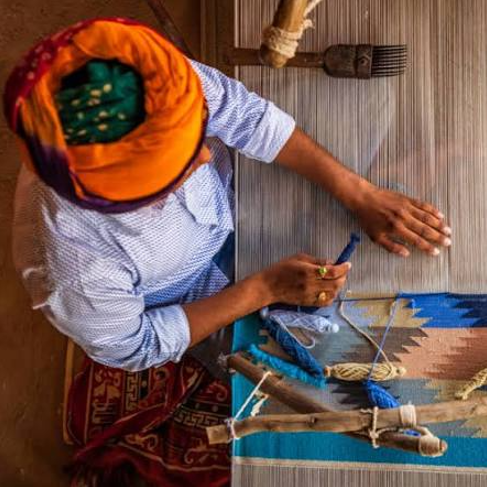
India has a vast and deeply skilled network of artisans — people who have spent years, sometimes decades, mastering a single craft. Block printing. Chikankari embroidery. Hand-weaving. Natural dyeing. These are not skills you pick up in a weekend. They are inherited, refined, and passed down through communities that have built their identity around them.
When we say “woven with care,” the first thing we mean is this: we know who makes our clothes.
Not in the abstract. Not as a supply chain category. We mean we have relationships with the people and workshops involved in producing every piece — and those relationships are built on:
- Respect for skill. We don’t treat artisans as interchangeable labour. Their expertise is the product.
- Fair compensation. The people who make our clothes are paid for the time and craft involved — not squeezed to hit a price point.
- Consistency. We return to the same makers, building long-term partnerships rather than switching vendors for marginal cost savings.
- Collaboration. When something isn’t working — a stitch, a finish, a proportion — we figure it out together.
Ethical clothing production in India means being honest about this chain of relationships. It means making sure that every person involved in creating a piece is treated with the same care we want the final product to carry.
What Handcrafted Actually Involves
There’s a reason artisan-made clothes take longer and cost more than mass-produced alternatives. The process simply cannot be rushed without losing what makes it valuable.
Here’s what goes into a single handcrafted piece at Unapologetic:
Fabric selection. Before anything is cut or stitched, the fabric is chosen with intent. We look at hand feel, weight, breathability, and how the material behaves over time — not just how it photographs. Natural fibres, ethically sourced textiles, and fabrics that age well take priority over cheaper synthetic alternatives.
Pattern making and sampling. Each design goes through multiple rounds of sampling before it’s approved. Proportions are adjusted. Seams are tested. Fit is evaluated across different body types. This process exists entirely to serve the final wearer — and it takes time.
The making itself. Whether it’s hand block printing, hand embroidery, or careful machine stitching by a skilled tailor, the actual construction of a garment is where the craft is most visible. Handcrafted fashion in India carries the evidence of human attention — slight variations that tell you a person, not a machine, made this.
Finishing and quality checks. The final stage before a piece leaves the workshop involves detailed inspection — loose threads, uneven hems, inconsistent printing. Nothing ships until it meets the standard.
This is premium craftsmanship in clothing. It’s not a marketing claim. It’s a production process that takes more time, more skill, and more care than the industry default.
Why Small Imperfections Are a Sign of Quality
One of the most important mindset shifts in understanding handcrafted fashion is learning to see slight variations not as flaws, but as signatures.
When a block is hand-pressed onto fabric, there will be subtle differences in ink density from print to print. When embroidery is done by hand, the tension of a stitch will vary slightly across a garment. When fabric is hand-dyed, the depth of colour won’t be perfectly uniform throughout a run.
These are not quality control failures. They are evidence of craft.
Mass production works precisely because it eliminates variation. Every unit is identical. Every print is mechanically consistent. Every seam is produced at the same speed by the same machine.
The result is technically perfect — and completely impersonal.
Artisan-made clothes carry something mass production cannot replicate: the trace of a human hand. At Unapologetic, we consider that a feature, not a flaw. When you receive a piece from us, the slight variation in your block print isn’t a mistake. It’s the mark of the person who made it.
The Long Game: Clothes Built to Last
Care in production isn’t just about the process. It’s about the outcome.
A quality clothing brand in India that genuinely cares about what it makes will always be thinking about longevity — how a piece holds up after ten washes, after two years of regular wear, after the trend it was adjacent to has passed.
At Unapologetic, longevity is a design principle, not an afterthought. It shapes decisions that customers rarely see:
- Seam allowances that hold up over time rather than fraying after a few washes
- Fabric weights chosen for durability as much as drape
- Dyes and prints tested for colourfastness so the piece looks as good in year two as it did on day one
- Silhouettes designed to transcend seasons rather than chase a trend that will feel dated in six months
This is what separates handmade clothing in India that’s genuinely premium from handmade clothing that’s simply expensive. The difference isn’t always visible on a hanger. It shows up in how the piece wears, and how long it lasts.
Holding Ourselves to the Standard
Here’s the part that most brands skip: accountability.
Saying “woven with care” is easy. Living up to it — season after season, piece after piece, even when the easier path is available — is where most brands fall short.
We’re not perfect. There are pieces we’ve sent back to the workshop because the finish wasn’t right. Collections we’ve delayed because the sampling process wasn’t ready. Decisions we’ve had to make that cost more in the short term because they were the right call for the long term.
We say this not to earn credit, but to be honest. Ethical clothing production in India requires constant, active commitment. It’s a standard you have to re-choose every time the pressure mounts to cut a corner.
“Woven with care” is our public commitment to keep choosing that standard. We’re telling you what we stand for so you can hold us to it.
Conclusion
Care in fashion is not a feeling. It’s a practice.
It’s in who makes the clothes and how they’re treated. It’s in the fabric chosen and the time spent on sampling. It’s in the decision to keep a small imperfection because it tells a true story. It’s in designing for the person who will wear the piece three years from now, not just the one who will photograph it today.
When Unapologetic says “woven with care,” we mean all of it. The artisan relationships. The quality checks. The slower process. The refusal to compromise on the things that matter — even when it would be easier to do so.
You deserve clothes that were made thinking of you. Not just as a customer, but as someone who will live in these pieces — who will wash them, wear them, love them, and pass them on.